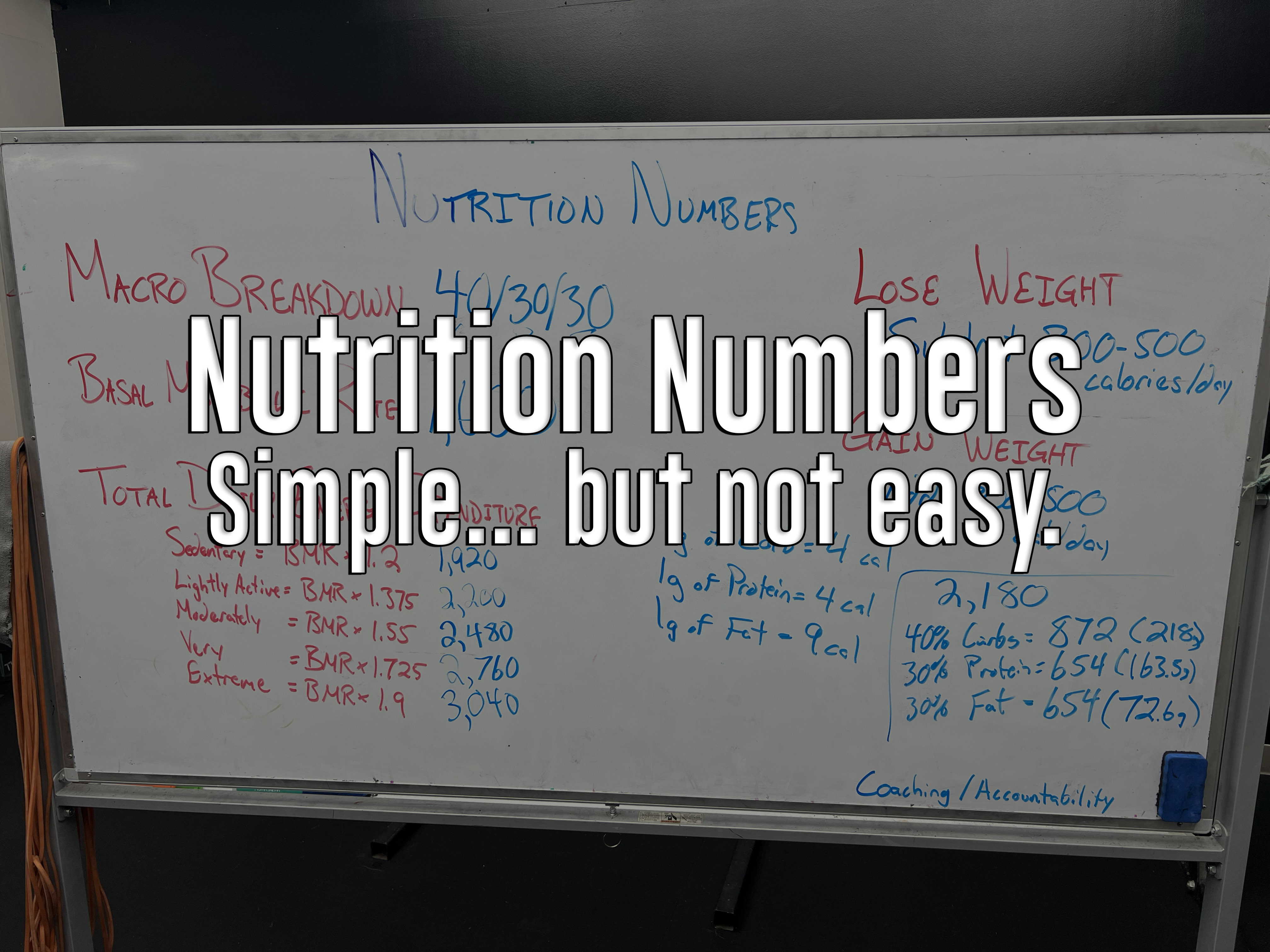

Nutrition can feel complicated.
Calories. Macros. Protein. Carbs. Fats. BMR. TDEE. Deficits. Surpluses. Tracking. Portions.
And then you open Instagram and somehow discover that you’re supposed to eat 147 grams of protein, avoid carbohydrates after 6 p.m., drink celery juice, and sacrifice a goat under a full moon.
It doesn’t have to be that complicated.
Nutrition is simple—but that doesn’t mean it’s easy.
For the average person who simply wants to become healthier, stronger, fitter, and feel better, there are a handful of numbers that can help make sense of the whole thing.
Let’s break it down.
Let's break down the three major macronutrients:
Each has a different role in your body.
Think of carbohydrates as your body’s primary source of energy.
Carbs include foods like:
They’re especially useful when you’re exercising and asking your body to perform.
Protein helps your body repair and rebuild muscle tissue.
When you work out, you’re creating stress on your muscles. Protein provides the building blocks your body uses to repair that tissue and make it stronger.
Good sources include lean meats, seafood, eggs, dairy, and plant-based sources such as lentils.
Fat plays an important role in keeping your body functioning properly. It supports your organs and helps with a variety of essential processes.
Good sources include things like nuts, seeds, oils, avocado, and fatty fish.
So we have our three macros.
But how much of each should you eat?
For someone who isn’t training for bodybuilding, Olympic weightlifting, or a professional sport, a simple starting point is:
40% carbohydrates 30% protein 30% fat
That’s 100% of your calories.
This isn’t some magical ratio that everyone on Earth needs to follow. It’s simply a practical starting point for the average person looking to improve their health, fitness, and nutrition.
But before we can figure out how much of each macro you need, we need to figure out how many calories you need.
And this is where things get a little more complicated.
Your Basal Metabolic Rate (BMR) is essentially the amount of energy your body needs just to exist.
Imagine lying in bed all day.
You’re not working.
You’re not exercising.
You’re not chasing kids around.
You’re not mowing the lawn.
You’re barely moving.
Your BMR is approximately how many calories your body would need to maintain itself under those conditions.
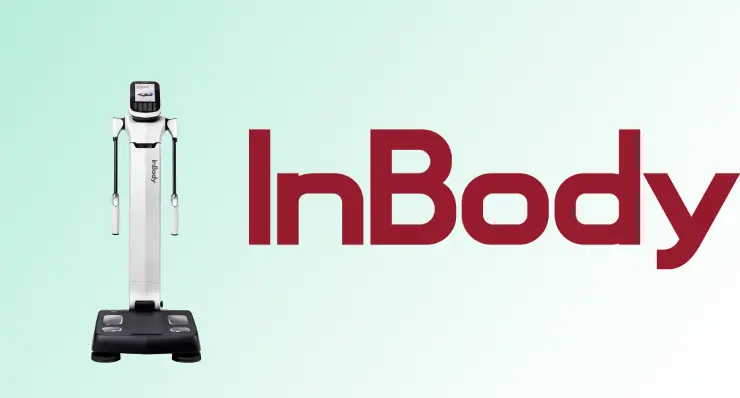
At Delaware Fit Factory, we use an InBody scanner to measure various biometric data, including BMR.
You can also get information through other professional testing methods.
The important thing is to understand that your BMR is not your daily calorie requirement.
It’s simply the starting point.
For our example, let’s say someone’s BMR is:
1,600 calories
That means their body needs approximately 1,600 calories just to maintain itself at rest.
But nobody actually lives their life lying motionless in bed.
So we need another number.
This is where TDEE comes into play.
TDEE stands for Total Daily Energy Expenditure.
Essentially, we’re taking your BMR and factoring in how active you are throughout your normal day.
Here’s the basic scale we’re using:
Activity Level - Multiplier
Sedentary - 1.2
Lightly Active - 1.375
Moderately Active - 1.55
Very Active - 1.725
Extremely Active - 1.9
Let’s use our example person with a BMR of 1,600 calories.
1,600 × 1.2 = 1,920 calories
1,600 × 1.375 = 2,200 calories
1,600 × 1.55 = 2,480 calories
1,600 × 1.725 = 2,760 calories
1,600 × 1.9 = 3,040 calories
That’s a pretty significant difference.
And that’s why looking at the “average” 2,000-calorie diet printed on a nutrition label isn’t particularly useful for determining what your body needs.
Everybody is different.
Now we know approximately how many calories someone needs to maintain their current weight.
But what if your goal is to lose weight?
Or gain weight?
That’s where we adjust the number.
For someone trying to lose weight, a starting point is to subtract approximately 300–500 calories per day.
For someone trying to gain weight, add approximately 300–500 calories per day.
Our moderately active person has:
BMR: 1,600
TDEE: 2,480
If they’re trying to lose weight, we could subtract 300 calories:
2,480 − 300 = 2,180 calories
So approximately 2,180 calories becomes their daily target.
If we wanted a larger deficit, we’d subtract 500:
2,480 − 500 = 1,980 calories
Again, these numbers are an example—not a prescription for everyone.
Let’s stick with our example:
2,180 calories per day
Using the 40/30/30 breakdown:
2,180 × 40% = 872 calories from carbohydrates
2,180 × 30% = 654 calories from protein
2,180 × 30% = 654 calories from fat
But we’re not done yet.
Because here’s where things get interesting:
A gram isn’t always a gram when it comes to calories.
One gram of carbohydrate contains approximately: 4 calories
One gram of protein contains approximately: 4 calories
One gram of fat contains approximately: 9 calories
That’s more than twice the calories per gram compared with protein and carbohydrates.
So let’s convert our example into actual grams for tracking purposes.
872 calories ÷ 4 = 218 grams
654 calories ÷ 4 = 163.5 grams
654 calories ÷ 9 = 72.6 grams
So our example person ends up with approximately:
2,180 calories
218g carbohydrates
164g protein
73g fat
That’s the math.
This is one reason tracking your food can be useful.
Consider protein sources.
Chicken breast is generally very high in protein and relatively low in fat.
Shrimp is another example of a food that provides a lot of protein without much fat.
Then there’s salmon.
Salmon is an excellent food and provides plenty of protein—but it’s also a much higher-fat protein source.
That doesn’t make salmon bad.
It just means that fat is calorie-dense.
The same thing can happen with cooking oils, peanut butter, fatty cuts of meat, and other foods.
For example, lots of us LOVE peanut butter and somewhere along the way we were told peanut butter was a protein source...
But peanut butter is primarily a fat source that contains protein, not a protein source that happens to contain fat.
That distinction can matter when you’re trying to understand where your calories are coming from.
Here’s where I think we need to take a step back.
Because while all of this math is useful, not everyone needs to live their life with a calculator and food scale.
If you're a data-driven person (like owner of DFF Doug Wattenschaidt is), and you like knowing your numbers, you canuse food-tracking apps like Macrostax or the Healthy Steps Nutrition App.
But maybe that’s not you.
Maybe you’re a dentist.
Maybe you work in an office.
Maybe you’re a teacher.
Maybe you’re a stay-at-home parent.
Maybe you have approximately 14 things going on at any given moment.
You don’t need to become a nutrition guru or fitness professional. And that’s okay.
That’s really the point of this entire conversation.
Nutrition can be broken down into math.
But knowing the math doesn’t automatically make it easy to follow.
You can know exactly how many calories you should eat and still struggle with:
That’s where coaching and accountability can make a huge difference.
If you’re extremely data-driven, there are tools that can help you track your calories and macros.
If you’re someone who would rather focus on building better habits than obsessing over numbers, that’s an option too.
At Delaware Fit Factory, our nutrition coaching focuses heavily on helping people develop sustainable lifestyles, regardless if you're a data-driven food tracker or a habit-stacking newbie.
Sometimes the solution isn’t another spreadsheet. Sometimes it’s figuring out why you’re eating an entire jar of peanut butter every night.
The goal isn’t perfection. The goal is to build a system that you can actually live with.
You can go very deep into nutrition.
You can debate different types of carbohydrates.
You can debate protein sources.
You can talk about nutrient timing, digestion, glucose, supplements, meal timing, fiber, micronutrients, and a thousand other things.
And there is certainly value in understanding those things.
But if you’re the average person who simply wants to become healthier and fitter, don’t let the complexity distract you from the fundamentals.
Start here:
Calories matter.
Protein matters.
Carbohydrates and fats matter.
Your activity level matters.
Your goal matters.
And perhaps most importantly:
Consistency matters.
If you somehow made it this far and your eyes have glazed over from all the math, here’s the entire post in a nutshell:
Simple? Yes.
Easy? Absolutely not.
And that’s okay.
You don’t need to know everything about nutrition to start making better choices.
You just need to start.
If you’re struggling to figure out where to begin, come talk to the team at Delaware Fit Factory. We love this stuff. We love talking about nutrition, training, habits, and helping people find a system that actually works for their lives.
Because ultimately, the goal isn’t to become obsessed with nutrition numbers.
The goal is to eat better, sleep better, train better, and be BETTER EVERY DAY!